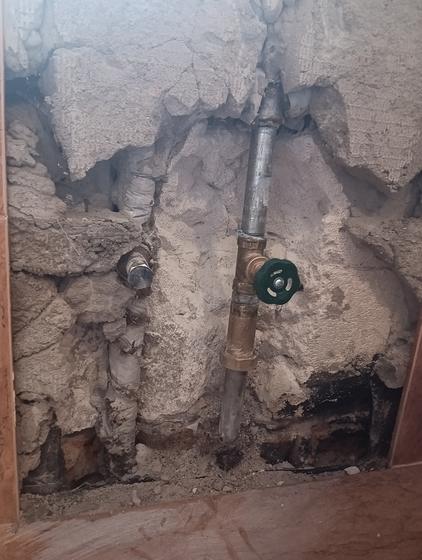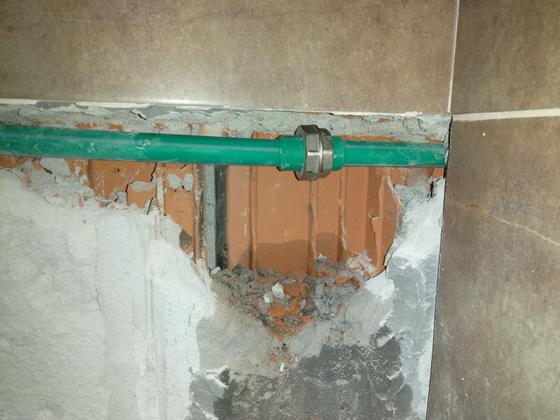

A water shut-off valve can stand in the same position for years and appear to be completely sound.
The problem is often discovered only when a leak appears, when a tap has to be replaced or when some other work is about to start, and we try to shut the water off.
The lever or the wheel then moves with difficulty, the valve cannot be closed all the way, or it does close but the water still passes.
The reason is simple: a valve that is not used is not a valve that does not wear.
Even at rest, its internal parts have been in contact with water, pressure, mineral deposits and corrosion processes for years.
What does a valve actually do?
The task of a shut-off valve is to interrupt the flow of water through the pipe when needed.
Depending on the design, this is achieved in different ways.
In a ball valve there is a metal ball with an opening inside the body. When the opening is aligned with the pipe, water passes. Turning the ball by about 90 degrees closes the flow.
In classic valves with a spindle, closing is done by moving the shut-off element towards the valve seat.
The designs differ, but the same rule applies to each of them:
the moving parts must really be able to move, and the sealing surfaces must remain able to interrupt the flow.
Standing still for many years can endanger both.
Scale and other deposits
Water from the mains contains dissolved minerals and various particles.
Over the years, deposits can form on the internal surfaces of the valve.
They can appear:
- around the ball;
- on the seats;
- around the spindle;
- on the sealing surfaces;
- in the space through which the moving element travels.
While the valve stands fully open, this sometimes has no visible effect on the everyday work of the installation.
But when we try to close it for the first time after ten years, the moving part has to travel across surfaces on which deposits have been forming for years.
The valve can then become extremely stiff or impossible to move with normal force at all.
Corrosion
The metal parts of the valve are continuously exposed to water and moisture.
The degree of corrosion depends on:
- the material of the valve;
- the quality of the water;
- the temperature;
- the conditions of the installation;
- the quality of the product itself;
- its age.
Corrosion can increase the friction between moving parts, damage the sealing surfaces or weaken the spindle and other mechanical parts.
It is especially unfavourable when the valve has not been moved for years, because the corrosion products and deposits are not disturbed by occasional movement of the mechanism.
Seals age as well
Besides metal parts, valves also contain various sealing elements.
Over time these can:
- harden;
- lose elasticity;
- become deformed;
- stick to the contact surface;
- be mechanically damaged at the first movement after many years.
That is why a valve sometimes seems sound as long as it is not touched.
After the first closing it can start to weep around the spindle or can no longer stop the flow completely.
That does not necessarily mean that turning the valve alone caused the fault.
Often the movement has only revealed a condition that had already existed for years.
Why does the valve close and the water still pass?
The mechanism can move normally, but that does not guarantee that the water is fully shut off.
For a valve to close well, its sealing surfaces have to seat properly.
If between them there are:
- scale;
- corrosion products;
- sand;
- fine particles from the installation;
- remains of a damaged seal,
a small passage can remain through which the water keeps flowing.
That is why there is a difference between:
"the valve can be turned"
and
"the valve reliably shuts the water off".
Whether the main shut-off valve is sound is judged by its real ability to isolate the installation.
Why is a ball valve sometimes very hard to move?
In a ball valve the ball seats against sealing seats.
When it stands in the same position for years, the combination of pressure, deposits and ageing of the sealing materials can significantly increase the force needed for the first movement.
The long lever of a ball valve gives a large mechanical torque, so there is a temptation simply to force the valve.
That is not always a good solution.
If the mechanism has seized, excessive force can lead to:
- breaking the lever;
- damage to the spindle;
- damage to the seal;
- cracking of the old valve or of the joint;
- the appearance of a leak.
It is especially unfavourable if all of that happens at the very moment when we are trying to use the valve because of a failure that is already under way.
Why is the main valve critical?
A faulty valve under a single tap is an inconvenience.
A faulty main valve of a flat or of a building is a much bigger problem.
If a flexible hose, a tap, a cistern or another part of the installation bursts, the first measure is usually to shut the water off.
If the main valve then cannot be moved or does not stop the flow, a small local fault can turn into a serious flood.
That is why the moment of a failure is not a good moment for the first check of a main valve after fifteen years.
Should valves be moved from time to time?
It makes sense to check a shut-off valve from time to time under controlled conditions, rather than waiting for it to be used for the first time during a failure.
On suitable valves, periodically moving the mechanism fully or partly can reduce the chance that it becomes immovable after a long rest.
However, on a very old, corroded or already suspect valve it is not wise to apply great force without an assessment, just to "free it up".
If there are:
- heavy corrosion;
- traces of an earlier leak;
- a damaged lever or spindle;
- very high resistance when trying to move it,
one should also reckon with the possibility that the valve will start leaking after it has been moved.
How to check whether the main valve really works?
It is not enough just to turn the lever.
After closing it, you have to check whether the flow has really stopped.
The simplest way is to open a tap downstream of the valve.
A short run of water that has remained in the pipes is normal.
But if a steady flow still remains after that, the valve does not close completely.
A small amount of water passing continuously may not matter in everyday use, but it can be a serious problem when a part of the installation has to be dismantled.
When should a valve be replaced?
Replacement is justified when the valve:
- cannot be opened or closed normally;
- does not interrupt the flow;
- leaks around the spindle or the body;
- shows pronounced corrosion;
- has a damaged mechanism;
- requires disproportionate force to operate;
- can no longer reliably perform its basic function.
On main shut-off valves reliability matters especially.
Such a valve may not be needed for years.
But when it is needed, it will often be needed immediately.
The essential point
A shut-off valve does not fail only through use.
It ages while it stands still as well.
For years it is acted upon by:
water + pressure + mineral deposits + corrosion + ageing of the seals.
If the mechanism is never moved, the first attempt to close it after many years can reveal all the consequences of that ageing at once.
So a main valve is not sound merely because nothing is leaking from it at the moment.
It is sound only when it can be moved safely and when it really can shut the water off when that is needed.