
A weak jet at a tap does not automatically mean that the pressure in the water mains is low.
Pressure and flow are not the same thing.
It is possible for the installation to have perfectly good static pressure while only a small amount of water passes through a particular tap.
The reason is most often some local restriction or resistance in the part of the installation between the water supply and the outlet itself.
So with this kind of problem it is important to establish first:
whether the flow is weak in the whole building or only in one place.
Pressure and flow are not the same
Pressure is the potential that moves water through the installation.
Flow is the amount of water that actually passes through a pipe, a valve, a mixer and an outlet in a unit of time.
We can have good pressure at the inlet, but if there is a large restriction somewhere along the way of the water, the flow will be small.
A simple example is a hose that is almost closed.
In front of the restriction the pressure can be normal, but only a small amount of water passes through the small opening.
The same principle applies in a water installation.
First check whether the problem is only at one tap
If the flow is weak only in one place, the cause is most likely local.
If the flow is weak:
- at all the taps;
- both on cold and on hot water;
- in the whole flat,
then the cause should be looked for closer to the main supply, the valve, the pressure reducer or the installation itself.
If the other taps work normally, there is not much sense in suspecting the water mains first.
The aerator is one of the most common causes
At the outlet of most modern taps there is an aerator.
It shapes the jet, mixes the water with air and limits the flow to a designed value.
At the same time it is one of the places where the following are most easily retained:
- scale;
- sand;
- rust;
- small pieces of seals;
- dirt that entered the installation after works.
When the mesh of the aerator gets blocked, the jet becomes weak or irregular.
Sometimes the water sprays sideways, and sometimes it seems as if the pressure in the whole installation has dropped.
The simplest check is to remove the aerator and briefly run the water without it.
If the flow is normal at once, the cause has been found.
Filters at the inlet of the mixer
Some mixers have fine filters on their connections.
Their function is to prevent dirt from entering the ceramic mechanism and other sensitive parts of the mixer.
After works on the water mains or on an old installation, particles can enter the water and be retained on exactly those meshes.
The aerator can then be completely clean and the flow still weak.
So in a diagnosis it is not enough to check only the end of the outlet.
The flexible hose
Water usually reaches a pillar mixer through one or two flexible connection hoses.
They too can restrict the flow.
The possible problems are:
- a sharp kink;
- twisting of the hose;
- internal deformation;
- deposits;
- damage to the inner layer;
- an unsuitable internal diameter.
From the outside a hose sometimes looks perfectly normal, while inside it can be significantly restricted.
So with a weak flow it makes sense to check the section between the angle valve and the mixer itself as well.
The angle valve
The angle valve under the basin or the sink can be another place of great resistance.
A problem can arise if it is:
- partly closed;
- old and corroded inside;
- blocked by deposits;
- damaged;
- if the valve mechanism has stayed in a position that does not allow full flow.
With old valves it is not rare for the handle to turn as if the valve were fully open, while the internal mechanism does not actually open the full cross section.
The ceramic mechanism of the mixer
In a single-lever mixer the water passes through relatively small channels in the ceramic cartridge.
If dirt settles in them or the mechanism is damaged, the flow can be restricted.
The symptoms can vary:
- a weak flow of both hot and cold water;
- a weak flow only in one position of the lever;
- uneven mixing;
- a change of flow when the lever is moved.
In such a situation the problem is not in the water pressure in the flat but in the mixer itself.
If only the hot water is weak
This is an important diagnostic fact.
If on the same mixer the cold water has a good flow and the hot one is weak, then we know that:
- the aerator;
- the common part of the outlet;
- a large part of the mixer mechanism
are probably able to pass a normal flow.
The problem should then be looked for on the hot water side.
The possible causes are:
- a partly closed valve;
- a blocked connection hose;
- deposits in part of the mixer;
- a problem at the outlet of the water heater;
- a safety or other valve that restricts the flow;
- a restriction in the hot water pipe.
If only the cold water is weak
The logic is the same.
If the hot water has a normal flow and the cold one does not, the problem is most likely on the cold water branch up to the mixer.
That significantly reduces the number of possible causes.
Good diagnostics work exactly like that:
we do not ask straight away what is broken, but what the symptom lets us rule out.
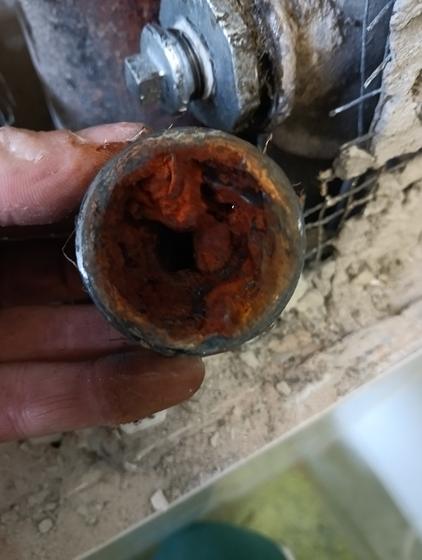
An old galvanised installation
With old galvanised pipes the problem can be deeper in the installation.
Over several decades the following can develop inside the pipe:
- corrosion products;
- mineral deposits;
- local restrictions.
The external diameter of the pipe stays the same, but the available internal cross section can be significantly reduced.
Such an installation can have perfectly good static pressure when all the taps are closed.
As soon as we open a tap and ask for a greater flow, the high hydraulic resistance of the old pipe causes a significant pressure drop along the line.
The user sees that only as a weak jet.
Why can a pressure gauge show good pressure while the tap still works poorly?
Because it matters when we measure the pressure.
When there is no flow, we are measuring static pressure.
When we open a tap, the water starts to flow and pressure losses appear due to:
- friction in the pipes;
- restrictions;
- valves;
- fittings;
- filters;
- the mixer.
Then it is the dynamic pressure that interests us.
It is possible, for example, to have good static pressure at the supply but a large pressure drop as soon as we try to pass a larger amount of water through a blocked section.
So a single pressure measurement without flow does not prove that the whole installation is able to provide a good flow.
Very small restrictions can create a big problem
Hydraulic resistance rises steeply when the cross section through which the water passes is reduced.
So something that visually looks like a small restriction can significantly limit the flow.
This is especially pronounced with:
- the small openings in an aerator;
- filters;
- ceramic mechanisms;
- valves;
- partly blocked pipes.
For that reason the problem is often found in exactly the narrowest part of the system.
What if the flow is weak only when two taps are running?
That is a different symptom.
If one tap works well on its own but its flow drops sharply when another one is opened, it is possible that the supply pipe or some common element does not have enough flow capacity.
The cause can be:
- a small pipe diameter;
- a partly closed main valve;
- a blocked old installation;
- a faulty pressure reducer;
- a restriction at the water meter or another common element.
The problem is then no longer local to one tap.
How is the problem looked for systematically?
The simplest way is to go from the end of the system towards the source.
The order can be:
the aerator ↓ the mixer itself ↓ the connection hoses ↓ the angle valve ↓ the branch of the installation ↓ the main valve / reducer / supply
At every step we check whether there is a normal flow at that place.
As soon as we find the point after which the flow drops significantly, we have narrowed down the place of the fault considerably.
Why should the mixer not be replaced straight away?
Because the mixer is not the only cause of a weak flow.
If a new mixer is connected to:
- a blocked hose;
- a faulty valve;
- an old, overgrown pipe,
the problem will stay the same.
A correct diagnosis should first establish where the restriction arises, and only then should the faulty part be replaced.
The essential point
A weak jet does not necessarily mean low pressure.
We can have:
good pressure + high resistance to flow = a small amount of water at the tap.
The most common causes are:
- a blocked aerator;
- a dirty filter;
- a problem in the mixer;
- a deformed or blocked connection hose;
- a partly closed or faulty valve;
- an old, overgrown pipe;
- another local resistance in the installation.
So the question:
"What is the water pressure?"
is not always enough.
A more important question is often:
"Where on the way from the supply to the tap is the flow capacity being lost?"
Once those two notions are separated, diagnosing a weak jet becomes much simpler.