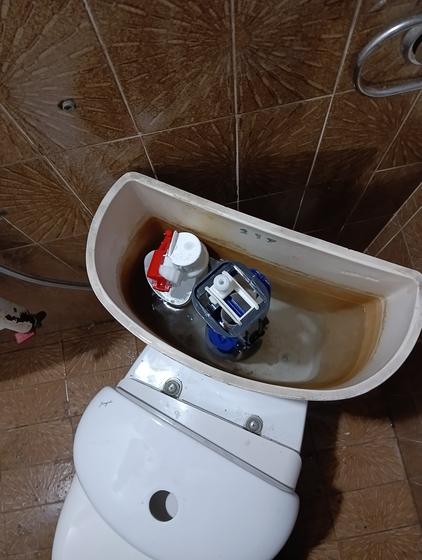

When a cistern keeps running water into the WC pan, the problem is usually not in the water supply itself but in one of the two mechanisms inside the cistern:
- the filling system;
- the system for flushing and closing the opening towards the pan.
Although the symptom looks simple, the water keeps flowing, the cause can be different.
So the most important thing is to establish first:
whether the water goes over the designed overflow or passes through a faulty flush mechanism.
How does a cistern work normally?
After flushing, the water from the cistern goes into the WC pan.
At the same time the filling valve opens and the cistern starts to fill up again.
As the water level rises, the float follows it and closes the inlet valve through the mechanism.
When the set level is reached:
the water supply closes.
At the next flush the flush mechanism opens, the water goes into the pan, then the outlet closes again and the cycle starts over.
So for a cistern to work properly, both of the following have to work properly:
the filling and the closing of the outlet.
The first case: the water does not stop during filling
If the filling valve does not close the inlet in time, the water level in the cistern keeps rising.
So that the water does not spill over the edge of the cistern and flood the bathroom, the flush system has an overflow.
When the water level reaches the height of the overflow, the excess water goes straight into the WC pan.
We then get the situation:
water keeps entering the cistern → the level rises → the water enters the overflow → it runs into the pan continuously.
In that case the problem is to be looked for in the filling system.
Why does the filling valve not close?
The possible causes are:
- the float is not adjusted correctly;
- the float cannot move freely;
- the mechanism is fouled with scale or dirt;
- the membrane or the seal of the valve is damaged;
- the mechanical parts are worn;
- dirt has remained inside the valve and prevents it from closing fully.
On older cisterns the float can be mounted on a lever, while modern mechanisms often have a compact float that slides vertically along the body of the valve.
The principle is the same in both cases:
the water level rises → the float lifts → the valve should close the inlet.
If that does not happen, the water keeps coming in.
How to recognise that the water is going over the overflow?
A simple sign is the water level in the cistern.
If it is very high and the water is obviously entering the central overflow pipe, the problem is almost certainly in the filling or in the level setting.
In such a case the flush seal can be completely sound.
It is not the cause of the leak.
The water simply reaches a place that is designed as a protective overflow.
The second case: the water level is normal, but water still passes into the pan
This is the other common scenario.
The cistern fills up to the normal height.
The filling valve closes.
But the water slowly keeps going into the WC pan.
Then the problem is most often not in the inlet valve but in the flush mechanism.
At the bottom of the cistern there is an opening through which the water goes into the pan during flushing.
When the flush stops, that opening has to be completely closed by a sealing element.
If the sealing is not good, water passes through continuously.
Why does the flush valve not close properly?
The possible causes are:
- a worn rubber seal;
- scale on the sealing surface;
- dirt between the seal and its seat;
- deformed rubber;
- an incorrectly fitted mechanism;
- mechanical damage to the flush assembly.
Two sound surfaces are needed for good closing:
the seal + the seat on which it rests.
If one of them is damaged or dirty, water can pass even through a very small gap.
Why does the cistern then start refilling from time to time?
This is a typical symptom of a small leak through the flush mechanism.
The process looks like this:
the cistern fills up ↓ the filling valve closes ↓ a small amount of water leaks into the pan ↓ the water level in the cistern slowly drops ↓ the float goes down ↓ the filling valve opens again ↓ the cistern tops up the lost water
The user can then hear the cistern briefly "hiss" every few minutes and top itself up again.
That is not normal behaviour.
Water is going somewhere out of the cistern.
Why is a small leak often not noticed?
The water from the cistern goes straight into the WC pan and on into the sewer.
There is no puddle.
There is no wet floor.
There is no visible damage.
That is why the fault can last for months.
It is often noticed only when:
- the user hears a continuous hissing;
- notices water running in the pan;
- gets an unexpectedly large water bill;
- the water meter shows consumption even when all the taps are closed.
Exactly for that reason a small cistern fault can cause a significant unnecessary consumption of water.
How much water can be lost?
Even a very small continuous flow becomes significant when it lasts 24 hours a day.
For example, if only the following passes through the cistern continuously:
0.1 litre per minute
that is:
6 litres per hour
that is:
144 litres per day
and more than:
4,000 litres per month.
If the flow is greater, the losses very quickly become tens of cubic metres.
So "it only leaks a little into the pan" is not necessarily an insignificant fault.
Scale as a cause
A cistern works with fresh water all the time.
So mineral deposits can form on its mechanisms over time.
Scale can:
- prevent the float from moving freely;
- interfere with the work of the membrane;
- create an uneven sealing surface;
- prevent the flush seal from seating well;
- block fine channels in the mechanism.
Sometimes it is enough to clean the mechanism.
In other cases the seal is already permanently deformed or worn and has to be replaced.
Should the whole mechanism be replaced?
Not always.
If the problem is only in the seal and the rest of the mechanism is sound, replacing the sealing element is sometimes enough.
If the mechanism is:
- old;
- brittle;
- heavily covered with deposits;
- mechanically worn;
- repaired several times,
it is often more sensible to replace the whole assembly.
The price of the mechanism itself is usually relatively small compared with the time needed to open the cistern again and repair various parts of the old system.
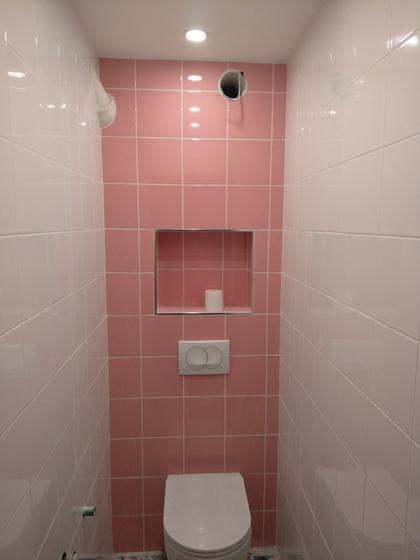
Concealed cisterns
In concealed cisterns the mechanism is not directly visible, but the working principle is the same.
Access to the service parts is usually provided through the opening behind the flush plate.
There too there are:
- an inlet valve;
- a float;
- a flush mechanism;
- an overflow;
- seals.
So the fact that a cistern is built into the wall does not automatically mean that the wall has to be broken open for every fault.
Quality systems are designed so that the basic mechanisms can be serviced through the service opening provided.
How to establish simply which side is causing the problem?
First the water level should be looked at.
If the water reaches or exceeds the level of the overflow:
check the inlet valve and the float.
If the water level is below the overflow but water still enters the pan:
check the flush valve and its seal.
That is the basic diagnostic algorithm.
Food colouring as a simple test
With a small and hardly visible leak, a small amount of food colouring can be added to the water in the cistern.
Without flushing, one should wait for some time.
If the coloured water appears in the WC pan while the flush has not been activated, water is passing through the flush mechanism.
This test does not say why the seal is letting water through, but it confirms that there is a connection between the cistern and the pan when the outlet should be closed.
What if the water meter still shows consumption?
If all the taps are closed, the machines are not using water and the meter still moves, the cistern is one of the first places to check.
The reason is that its leak can be almost invisible.
The water goes straight into the sewer.
If the cistern valve is closed and the movement of the meter stops, the place of the loss is practically localised.
Why should you not simply reduce the water supply?
Sometimes the problem is "solved" by partly closing the angle valve in front of the cistern.
That reduces the filling speed and perhaps makes the noise quieter.
But a faulty mechanism stays faulty.
If the flush valve lets water through, the water will still keep going away, only the cistern will refill more slowly.
If the filling valve does not close, a reduced flow does not repair its function either.
The solution is to remove the cause, not to limit the symptom.
The essential point
When a cistern keeps running water, there are two main scenarios:
the water goes over the overflow → the problem is most likely in the filling, in the float or in the inlet valve.
the water does not reach the overflow but still goes into the pan → the problem is most likely in the flush mechanism or in its seal.
So the basic logic is simple:
first establish by which route the water is leaving, and only then look for the faulty part.
Although the fault is most often not technically complicated, ignoring it can waste water continuously for months.
So a cistern that "only leaks a little" is not merely a question of noise or comfort.
It is an open tap that we often do not see at all.