
Flexible connection hoses are found almost everywhere in domestic plumbing: under washbasins and sinks, on cisterns, water heaters and various household appliances.
They are cheap, simple to fit and they allow elements to be connected without precise alignment of rigid pipes.
At the same time they are one of the places in a plumbing system whose failure can cause great damage in a very short time.
The reason is simple: a flexible hose is a relatively thin and mechanically loaded element that is under water pressure continuously.
What is a flexible hose made of?
A typical flexible connection hose is not a metal pipe.
Its basic part is an inner hose of an elastomeric or other suitable material through which the water flows.
Around it there is a reinforcement, most often a metal braid, which limits the expansion of the inner hose under pressure and increases its mechanical strength.
At the ends there are connection fittings joined to the hose by crimping or another process.
So in one small element there are several potential points of failure:
- the inner hose;
- the outer reinforcement;
- the crimped joint;
- the connection fitting;
- the seal.
A fault in any of them can lead to a leak.
What is the metal braid for?
The outer braid is often wrongly seen as a layer through which water cannot pass.
It is not that.
Its basic function is the mechanical reinforcement of the inner hose.
When the hose is under pressure, the inner elastic layer tends to expand. The braid limits that expansion and takes over part of the mechanical load.
If the braid corrodes significantly, breaks or loses its mechanical strength, the inner hose can start to expand at that place.
A local bulge can appear first, and then a burst.
A corroded or damaged braid is therefore not merely a cosmetic flaw.
Why does a flexible hose burst?
There is usually not just one cause.
Failure can be brought about by a combination of material ageing, pressure, temperature, the way it was fitted and the conditions around it.
Ageing of the inner hose
Elastic materials change their properties over time.
Under the influence of temperature, water, mechanical stress and time they can become harder, lose elasticity or develop small defects.
The hose can look perfectly decent from the outside while that happens.
That is exactly why a visual check is not a perfect way to judge how much life it has left.
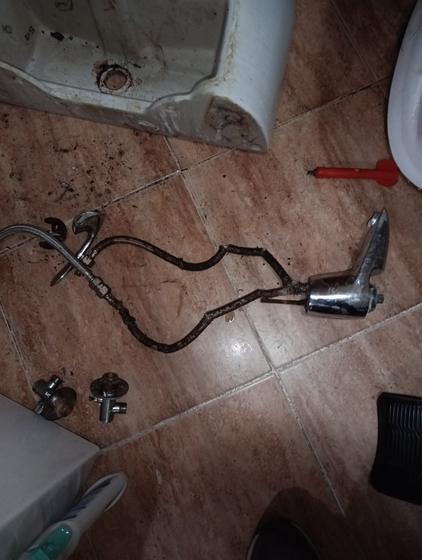
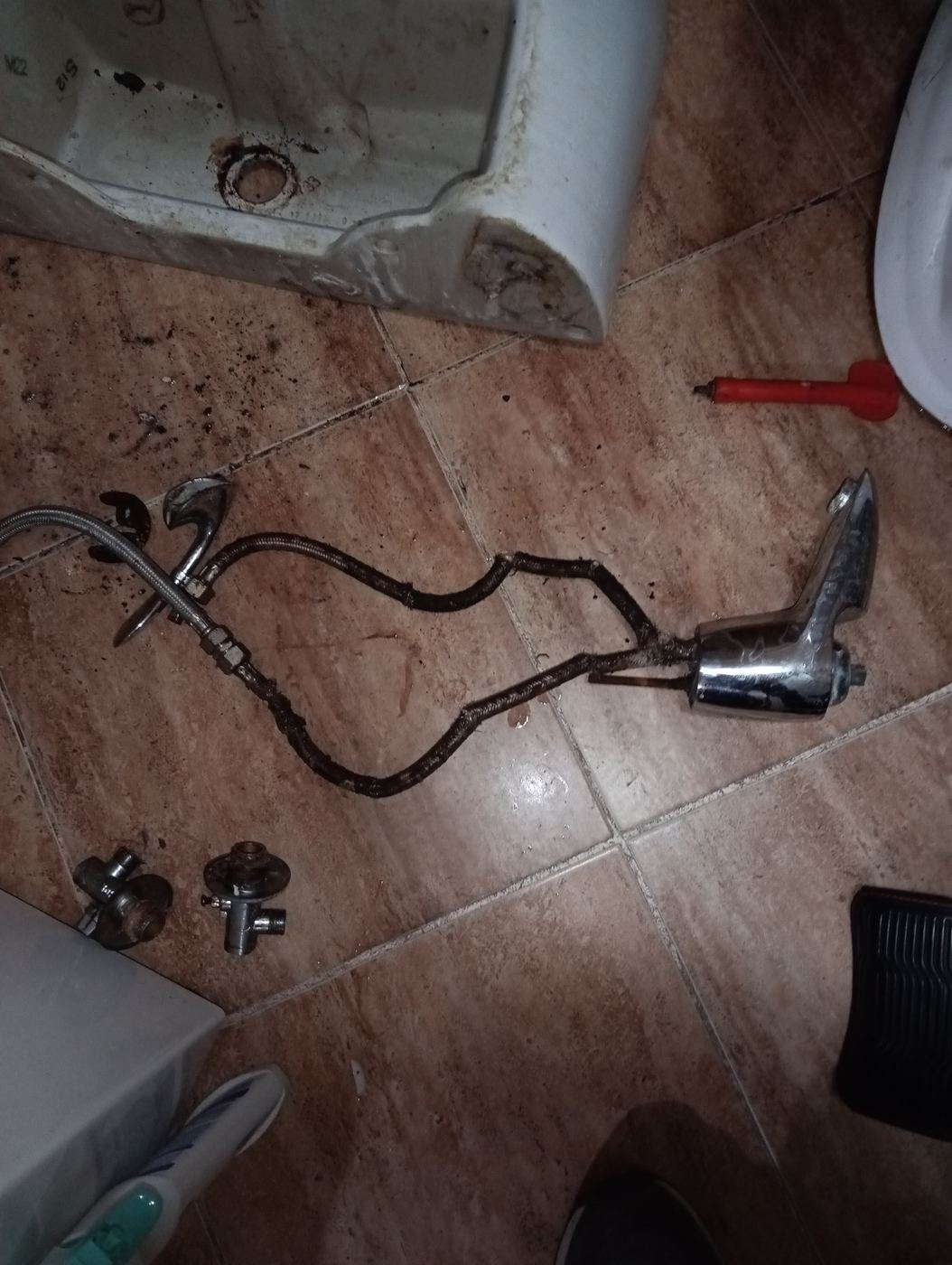
Corrosion of the outer braid
The space under a sink or a washbasin is often damp.
Cleaning agents, condensation, occasional leaks and other moisture can speed up the corrosion of the metal reinforcement.
Particular attention should be paid to a hose on which:
- individual wires of the braid are broken;
- there are visible traces of corrosion;
- the braid has darkened or is falling apart;
- the inner hose has started to come out through the braid.
Such a hose should not be left until it starts leaking.
Excessive bending
Flexible does not mean that a hose can be bent at any angle.
If a hose that is too long is stuffed into a small space, a sharp kink can be created.
At that place the inner hose is deformed and the braid is loaded unevenly.
It is particularly unfavourable when the hose changes direction abruptly right next to the crimped fitting.
It is better to choose a suitable length and make a gentle curve than to bend the hose at a sharp angle.
Twisting the hose during installation
One of the common installation mistakes is torsional twisting of the hose.
When the threaded fitting is tightened, the whole hose can turn with it.
The braid and the inner layer then stay permanently twisted.
A hose is designed to be flexible in bending, but that does not mean it should be permanently loaded in torsion.
That is why the body of the hose should be kept from turning while the fitting is being tightened.
Pressure in the plumbing system
Every hose has permitted working conditions.
If the pressure in the system is too high, the mechanical load on all of its parts is greater.
Short pressure surges are a particular problem.
Sudden closing of the water, solenoid valves in household appliances and other rapid disturbances of flow can cause water hammer.
Such a pressure does not have to last long to put additional load on a hose or a fitting that is already weakened.
That is why frequent bursting of hoses on the same installation should not always be solved simply by fitting a new hose. The conditions it works in should be checked too.
Water temperature
Hoses on hot water are exposed to a greater temperature load than hoses working only with cold water.
A higher temperature speeds up the ageing of many elastomeric materials.
A hose therefore has to be intended for the temperature and the purpose it is used for.
Hoses that look alike do not have to have the same working characteristics.
The joint between the hose and the fitting
A very important place is the crimped end of the hose.
That is where the flexible and the rigid part meet, and it is exactly there that significant mechanical stresses occur.
A poor product, corrosion, incorrect installation or long-term bending right at the fitting can lead to a leak or to the joint separating completely.
That is why a hose that is wet around the crimped part should be replaced even when the leak seems negligible.
Why is a complete burst more dangerous than a small leak?
A small leak is usually noticed.
A complete mechanical failure is different.
If a hose bursts while the valve in front of it is open, we no longer have dripping but practically an open water line.
The amount of water that will come out depends on the pressure, the size of the opening and the characteristics of the installation, but in a relatively short time it can be enough to flood the room and cause damage in neighbouring flats as well.
A particular problem is that the failure can happen when nobody is in the building.
Flexible hoses should therefore be seen as a consumable mechanical element of the installation, not as a part that is fitted once and then never checked again.
When should a flexible hose be replaced?
There is no single interval that applies to every hose.
The life depends on the product, the material, the temperature, the pressure, the quality of the water, the way it was fitted and the manufacturer's recommendation.
That is why an arbitrary rule such as „every hose is replaced after exactly five years“ is not technically correct for all products.
A hose should, however, be replaced without delay if the following are noticed:
- corrosion of the metal braid;
- broken wires in the braid;
- a bulge or deformation;
- cracking of the outer or inner material;
- moisture around the crimped joint;
- damage to the threaded fitting;
- marked stiffening or deformation;
- permanent twisting;
- a sharp kink that cannot be straightened out.
It is also advisable to check the age of existing hoses during other work on sanitary equipment.
If a mixer tap, a water heater or a cistern is being replaced, for example, it is not always sensible to reuse an old connection hose that has been loaded for years only because it is not leaking at that moment.
What should be checked after installation?
After a hose has been fitted, check:
- that the fittings do not leak;
- that the hose is not twisted;
- that there is no sharp kink;
- that it is not stretched taut;
- that it is not rubbing against a sharp edge;
- that it is of a suitable length;
- that the joints are not needlessly overloaded by tightening.
After the water is turned on, the system should be inspected under working pressure.
The joints should be checked especially after a few minutes, because a very small leak is sometimes not visible straight away.
Does a more expensive hose automatically mean a safer hose?
Not necessarily, but for an element that is under pressure continuously there is little sense in choosing a product solely by the lowest price.
More important are:
- the declared working pressure;
- the permitted temperature;
- the material;
- the quality of manufacture;
- the intended use;
- the origin and documentation of the product.
A flexible hose is a small item in the total cost of an installation, but its failure can cause disproportionately great damage.
The essential point
A flexible connection hose works thanks to the joint action of the inner watertight layer and the outer mechanical reinforcement.
In use it is exposed to:
pressure + temperature + ageing + bending + the conditions around it.
Because of that its working life is not unlimited.
The biggest problem is not that a hose has to be replaced one day, it is that for years nobody pays attention to it only because it is not leaking yet.
With a flexible hose a visible leak does not have to be the first sign of failure, sometimes it is already the last.