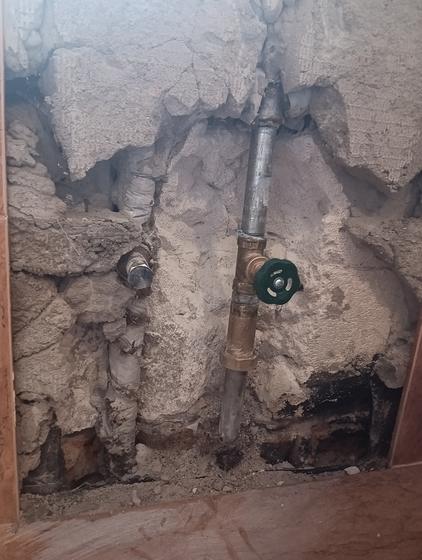

Threaded joints have for decades been one of the basic ways of joining steel water pipes.
In old galvanised installations it is precisely at the threads that serious corrosion, thinning of the material and finally leaking often appear first.
That is not by chance.
By cutting a thread on a pipe we change, at the same time:
- the condition of the protective surface;
- the thickness of the metal wall;
- the geometry of the surface;
- the distribution of mechanical stress.
That is why a thread is one of the more sensitive zones of a steel pipeline.
What actually happens when we cut a thread?
A thread is formed by removing material from the outside of the pipe.
What arises in turn is:
the crests of the thread → the flanks → the roots of the thread.
At the root of the thread the diameter of the metal part of the pipe is smaller than on the uncut part.
That means that exactly at that place the pipe has a smaller remaining thickness of material.
A thread therefore lets us make a mechanical joint, but we pay for it by partly removing the wall of the pipe.
What happens to the galvanised protection?
On a galvanised pipe the steel is protected by a layer of zinc.
If the pipe was galvanised first and we cut the thread later, on site or during a repair, the dies of the threading tool remove not only steel but also the existing zinc layer from the surfaces that form the thread.
On parts of the newly created surface the base steel can therefore remain exposed.
That is a different situation from a factory galvanised threaded element, where galvanising was done after the thread was formed and the protective layer exists on the threaded surfaces as well.
So it is not the same to:
cut a new thread on an already galvanised pipe
and
use a part whose already formed thread was galvanised afterwards.
Does the exposed steel start rusting immediately?
Not necessarily.
Zinc does not protect steel only as a physical coating.
It also has a sacrificial, that is, cathodic protective function.
Zinc is electrochemically more active than steel and, in the presence of an electrolyte, it can corrode instead of the neighbouring exposed steel surface.
For that reason small scratches, cut edges or other limited damage to the galvanised layer can be protected by the surrounding zinc for some time.
That is one of the great advantages of galvanising over an ordinary protective coating.
However, that protection is not endless.
The zinc is consumed in that process.
When there is no longer enough of it, or the exposed surface is large in relation to the amount of available zinc, the base steel becomes ever more directly exposed to corrosion.
Why is a thread nevertheless more critical than an ordinary scratch?
Because with a thread we do not have only damaged surface protection.
We also have a smaller amount of steel at the thinnest part of the cross section.
Let us imagine two areas of the same pipe.
On the smooth part the wall has its full thickness.
At the root of the thread, part of that thickness has already been removed mechanically during cutting.
If corrosion then takes, say, another few tenths of a millimetre of metal from the surface, the same loss of material matters more at a place that was already thinner.
So a relatively small depth of corrosion can have a far more serious consequence on a thread than on a full pipe wall.
The geometry of the thread concentrates stress as well
A smooth pipe has a relatively even geometry.
A thread is a system of notches.
The root of a thread is a local change of cross section and a place where mechanical stress is not distributed entirely evenly.
That is a well known mechanical principle: abrupt changes of geometry create a concentration of stress.
So the root of the thread is at the same time:
- a part with less material;
- a place where the geometry changes;
- a potentially exposed steel surface.
When corrosion is added to that, we get a naturally weaker point of the pipeline.
Why does an old galvanised pipe often crack right at the fitting?
In an old installation several processes act at the same time.
Over the years:
- the galvanised layer wears away;
- the steel corrodes;
- deposits form on the inside;
- the metal gradually loses thickness;
- the thread has a smaller cross section from the start.
In the end it is exactly the area right next to the fitting that can become the thinnest part of the whole pipe.
From the outside it sometimes looks as if "the fitting has eaten the pipe".
In reality it is often a combination of:
an initially reduced thickness at the thread + loss of the galvanised protection + many years of corrosion.
Internal corrosion can be even more dangerous
When we look at an old galvanised pipe from the outside, we see only half of the problem.
Corrosion can develop from the inside as well.
So on the threaded part we can have at the same time:
material mechanically removed from the outside
and
corrosion thinning from the inside.
The remaining metal cross section can then be much smaller than an external inspection would suggest.
This is one of the reasons why an old pipe sometimes looks healthy enough until we try to unscrew it.
Why does a pipe sometimes crack while a fitting is being removed?
When unscrewing an old fitting, we act on the pipe with a torque.
If the threaded part is healthy, the pipe takes that normally.
But if after several decades it is:
- corroded;
- thinned;
- locally cracked;
- mechanically weakened,
the torque we apply with a wrench can be enough for the remaining wall to twist or crack.
So with old galvanised installations it is not always safe to apply an ever longer lever just because the fitting will not come loose.
We may succeed in moving the fitting and at the same time destroy the pipe that goes into the wall.
Why does a pipe sometimes break just behind the thread?
A thread does not always end with a perfectly sharp boundary.
There is a transition between the cut part and the full cross section of the pipe.
That is an area in which both the geometry and the stiffness change.
If corrosion is present there, mechanical loading during tightening, unscrewing or moving the pipework can lead to a break in exactly that zone.
That is why with an old pipe only a corroded ring of thread sometimes stays in the fitting after dismantling, while the rest of the pipe comes away.
That is usually a sign that the problem did not arise at that moment.
The intervention only mechanically loaded a place that had already been critically weakened.
Does the sealing material protect the thread from corrosion?
Sealing material can limit the contact of part of the threaded surface with water and air, but its basic function is not anti-corrosion protection.
Hemp with a suitable sealing paste, PTFE tape and various thread sealants serve primarily to prevent water from passing through the helical gap of the thread.
So one should not assume:
"The thread is sealed, so the steel can no longer corrode."
The conditions inside the joint depend on how it was made, on the materials, on the age and on the presence of water.
Is every cut thread a problem?
No.
A properly made thread on a sound pipe is a normal way of joining steel installations, used for decades.
The problem is not the principle of a threaded joint itself.
The problem arises when the following add up:
an old pipe + lost protection + reduced wall thickness + corrosion + mechanical load.
So a new, properly made thread should not be seen in the same way as a thread on a pipe that has spent forty years in a water installation.
What should be assessed before cutting a new thread on an old pipe?
Before an old galvanised pipe is shortened and a new thread cut on it, one should assess whether there is enough healthy material for such an operation at all.
It is important to pay attention to:
- external corrosion;
- the condition of the existing thread;
- the thickness and strength of the wall;
- deformations;
- the age of the installation;
- the amount of internal deposits;
- the condition of the neighbouring parts of the pipework.
On a heavily corroded pipe a new thread is not always a repair.
The threading die removes further material from a pipe that may already not have enough of it.
In such a situation a more correct solution can be to replace a larger part of the old pipework, up to the place where the material is still healthy.
Why can a new thread look good and still be unreliable?
A threading die can produce a seemingly fine profile even on a pipe whose wall is already significantly thinned.
From the outside we get:
a correct thread + a new fitting + a joint that is not leaking at the moment.
But the mechanical reliability of that joint depends on the amount of healthy steel left under the root of the thread.
So the quality of a thread should not be judged only by:
"Could the fitting be screwed on?"
but also by the condition of the pipe on which the thread was made.
The essential point
A thread is a naturally more sensitive zone of a steel pipe because it brings several unfavourable factors together in one place.
When cutting it:
we remove part of the pipe wall ↓ we can remove part of the galvanised protection ↓ we create thread roots and a concentration of stress ↓ corrosion further reduces the remaining cross section over time ↓ the thinnest part finally becomes a potential point of failure
The zinc around the newly exposed surface can protect the steel cathodically for some time, so it is not correct to say that every freshly cut thread is immediately left completely unprotected.
But that protection is not unlimited either.
So with old galvanised installations the more important question is not only:
"Can we cut a thread here?"
but:
"How much healthy material will be left once we have cut it?"
On a pipe that has already corroded seriously, a good thread cannot make up for metal that no longer exists.