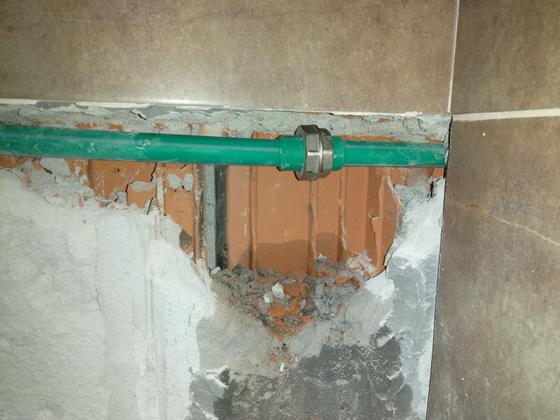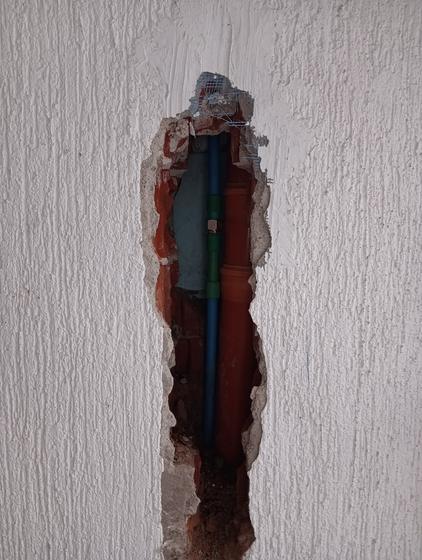

When repairing old water installations, the need often arises to join an existing galvanised steel pipe to a new part of the installation made of copper.
Mechanically, such a transition is not particularly complicated.
However, by joining two different metals in a system through which water flows, we can create the conditions for galvanic corrosion.
To understand why such a joint is potentially problematic, one has to understand what a galvanic pair is and what actually happens in it.
What is galvanic corrosion?
Different metals have a different electrochemical potential.
If two such metals are:
- connected electrically;
- and at the same time exposed to an electrolyte,
an electrochemical cell can arise.
In a water installation the water itself can act as the electrolyte.
One metal then becomes relatively more anodicand the other more cathodic.
Oxidation of the metal takes place at the anode, the metal atoms pass into ionic form and the material gradually corrodes.
The more cathodic metal is relatively protected in such a pair.
So with galvanic corrosion it is not necessary for both metals to deteriorate at the same rate.
On the contrary, one of them can corrode faster precisely because it is electrically connected to a more noble metal.
What happens when we join copper and galvanised steel?
In the copper and steel pair, copper is the more noble metal.
Steel is the more anodic one and, if conditions for a significant galvanic current are established, it is the side on which we expect accelerated corrosion.
With a galvanised pipe the situation is even more interesting, because there is zinc on the surface of the steel.
Zinc is an even more active metal, and that is exactly why it is used as protection for steel.
When galvanised steel is electrically connected to copper in the presence of water, galvanic conditions can accelerate the consumption of the galvanised protection and, after it is lost, the corrosion of the steel itself.
The Copper Development Association states that when a copper and a steel pipe are connected directly, the steel is the more electronegative and is the metal exposed to galvanic attack.
Three conditions are needed for galvanic corrosion
Put simply, the following have to exist at the same time:
two metals of different electrochemical potential
- electrical contact between them
- an electrolyte that enables ionic conduction
In our example:
copper + galvanised steel + water
can create a galvanic pair if the metals are electrically connected.
If we break the electrical connection between the metals, we have also broken one of the basic conditions for a classic galvanic cell.
Dielectric unions work on that principle.
Why does the problem usually arise close to the joint itself?
Galvanic corrosion in direct contact between different metals is most pronounced in the immediate vicinity of the joint.
The reason is that the electrical path through the metal is highly conductive, while water as an electrolyte has considerably higher resistance.
For that reason the strongest electrochemical action is concentrated around the place where the different metals meet directly.
The Copper Development Association states that with a direct copper to steel joint the galvanic attack is mostly concentrated on a relatively small area around the joint; corrosion far from that place usually has other causes as well.
So if we find a very old steel pipe that has corroded ten metres away from the copper transition, it is not enough to say:
"That is because somewhere it is joined to copper."
Galvanic corrosion has to be distinguished from the general corrosion of old steel.
The ratio of the metal areas matters a great deal
It is not all the same how large the anodic and how large the cathodic metal area is.
A particularly unfavourable combination is:
a small area of the anodic metal + a large area of the cathodic metal.
The galvanic current can then be concentrated on a relatively small area of the metal that corrodes.
In practical terms, a small piece of galvanised steel electrically connected to a large copper installation can be a less favourable combination than the reverse geometry.
So galvanic corrosion cannot be assessed only by the question:
"Which two metals are joined?"
The size of the areas, the composition of the water, the temperature, the flow rate, the condition of the protective layers and other conditions matter too.
There is another problem: copper need not even touch the galvanised pipe directly
This is particularly interesting in water installations.
Small amounts of copper can dissolve out of the copper part of the installation and be carried further through the system by the water.
If such water then comes into contact with galvanised steel, under certain conditions the copper can be deposited on the surface of the zinc.
Small areas of copper next to zinc then arise on the very surface of the galvanised pipe.
We have practically created a large number of tiny local galvanic cells.
The zinc around the deposited copper becomes more anodic and can corrode locally at an accelerated rate.
That is why the Copper Development Association warns in the technical literature that galvanised steel should not be placed downstream of copper pipes and fittings, because copper ions can deposit on the zinc and start local galvanic corrosion.
So why does the direction of water flow matter?
Let us imagine an installation:
copper → galvanised pipe
The water first passes through the copper part.
If it carries dissolved copper ions, they then reach the galvanised part and can deposit on its surface.
That is why this arrangement is unfavourable even when the two metals are not directly joined to one another.
With the reverse arrangement:
galvanised pipe → copper
that particular mechanism of transferring copper onto zinc is not the same.
That, however, does not mean that a direct metal joint between galvanised steel and copper becomes correct just because the water flows in a more favourable direction.
The possibility of a classic galvanic pair at the point of contact still remains.
How is the transition made properly?
When materials with a risk of galvanic corrosion have to be joined, one of the solutions is to separate the metals electrically.
Suitable dielectric unions, couplings or other system elements are used for that, whose construction prevents direct electrical contact between different metals.
The principle is:
copper │ electrical insulator │ steel
Water can still pass through the joint, but the metal parts no longer form one continuous electrical conductor.
That breaks the electrical path necessary for a classic galvanic current. Dielectric unions are used for exactly that reason, as one of the measures for separating different metals.
The specific type of transition must of course be rated for the pressure, the temperature and the purpose of the particular installation.
And what about a brass fitting in between?
In practice a brass fitting is often used as a transition between a steel and a copper installation.
Brass is a copper based alloy and has different electrochemical properties from steel.
Such a transition can be a practically and structurally better solution than joining certain materials directly, depending on the system and the working conditions.
But there is an important difference:
a brass fitting is not an electrical insulator.
If our aim is to break the galvanic electrical connection completely, an ordinary brass fitting does not do that.
So one should not confuse:
a transition fitting made of another metal
and
a dielectric union that electrically separates two parts of the installation.
Those are not the same functions.
Will every direct joint of copper and steel certainly fail?
No.
Galvanic corrosion is not a simple process about which we can say:
copper + steel = the pipe will leak in two years.
The intensity depends on:
- the electrical conductivity and chemical composition of the water;
- the temperature;
- the ratio of the metal areas;
- the condition of the protective layers;
- the presence of oxygen;
- the flow;
- deposition;
- the geometry of the joint.
In some systems different metals can be joined for years without a visible problem.
In other conditions local corrosion can be considerably faster.
The Copper Development Association itself stresses that the existence of two different metals and water does not automatically mean that the galvanic attack will be strong; the actual conditions of the electrolyte and the protective films on the metals have a great influence.
That, however, is no reason knowingly to make an unfavourable joint during a new repair if a technically more correct solution exists.
Why does this matter especially when repairing old installations?
In an old galvanised installation the steel has often already:
- lost part of the galvanised layer;
- corroded;
- thinned;
- been covered with internal deposits.
If we add a new copper part to such a system and make an unfavourable metal transition, we have not joined two new materials in ideal condition.
We have joined a new material to a pipe that may already have a very limited remaining life.
So it is sometimes more important to ask:
"Does it make sense to extend this old galvanised branch at all?"
than to look for the best way of adding another half metre of new pipe to it.
Galvanic corrosion is not the only cause of a joint failing
When we find corrosion at a transition between different materials, it is not correct to declare every change to be galvanic corrosion.
The following can act at the same time:
- general corrosion of the steel;
- local corrosion;
- corrosion under deposits;
- damage to the galvanised layer during thread cutting;
- the chemical composition of the water;
- external moisture;
- poor sealing;
- galvanic action.
A good diagnosis therefore does not start only with the question:
"Are there two different metals here?"
but:
"Where is the corrosion, which material has been attacked and what conditions exist at that place?"
The essential point
Galvanic corrosion arises when different metals in electrical contact and in the presence of an electrolyte form an electrochemical cell.
With copper and galvanised steel, the steel, that is the galvanised part of the system, is the one at a disadvantage.
The basic logic is:
copper and galvanised steel ↓ electrical contact ↓ water as an electrolyte ↓ a difference of electrochemical potentials ↓ a galvanic current ↓ accelerated corrosion of the more anodic material
Besides that, copper carried in dissolved form by the water can deposit on galvanised steel downstream and create local galvanic cells even when the direct copper to steel joint is not at that place.
So when an old galvanised installation is transitioned to copper, it is not enough to make a joint that is not leaking today.
A good transition also has to take into account what will be happening electrochemically at that joint for years.